
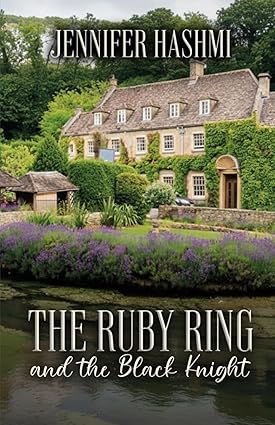
Most people have a drawer somewhere in their home, a place where old letters sit folded, where a photograph hides beneath a birthday card, where something small and forgotten carries a weight that no one talks about anymore. Jennifer Hasmi's debut novel, The Ruby Ring and the Black Knight, opens with exactly that kind of moment. A parcel arrives. A rosewood box is unwrapped. And with it, a question surfaces that will take an entire story to answer.
That question doesn't announce itself loudly. It arrives quietly, the way real secrets do.
When a Family Inheritance Means More Than Money
Set in the rolling English countryside of the Cotswolds, in Cirencester and Tavistock, and at the grand Ashcroft Manor, this novel centers on Bridget Kendall, a young environmental scientist living a carefully ordinary life in her village cottage. When her grandfather John, a solicitor who emigrated to Cape Town decades earlier, passes away, he leaves his estate to Bridget's father. But to Bridget specifically, he sends something else entirely: a polished rosewood box containing a gold ruby ring and a single chess piece, a knight, carved from onyx.
No note. No explanation.
Anyone who has ever inherited something unexpected from a grandparent, a piece of jewelry, an old letter, a faded photograph, knows the quiet ache of holding an object that clearly meant something to someone who is no longer around to explain why. Hasmi captures that feeling precisely. Bridget doesn't immediately go looking for answers. She sits with it. She savors it. And then, methodically, she starts to pull at the thread.
The Architecture of British Secrets
What makes The Ruby Ring and the Black Knight stand out in the crowded field of British family dramas is their refusal to reach for melodrama. The novel trusts its readers. It understands that in real English life, particularly in the world of manor houses, solicitors' offices, and village high streets, secrets don't explode. They exist, quietly, for decades.
When Bridget visits the law firm Brook and Taylor and then drives to Ashcroft Manor to speak with Sir Michael Featherstone, she uncovers something that has remained undisturbed for over fifty years. The chess piece fits back into its set. The ring matches one worn by Lady Maria in a photograph on the manor wall. And the implications, inheritance, identity, love, loyalty, unfold piece by piece.
Hasmi structures this revelation the same way a good solicitor might arrange a case: logically, calmly, with no single document proving everything, but each piece making the next one clearer.
Three Characters, One Unspoken Truth
At the heart of this story is a triangle that British fiction has rarely explored this honestly: a deeply private aristocrat, his reserved wife, and the charming young solicitor from South Africa who briefly became central to both of their lives.
Sir Roger Featherstone. Lady Maria. And John Kendall, Bridget's grandfather, whose face still hangs in the Ashcroft drawing room long after his departure.
The novel never turns its story into a scandal. It handles it with the same restraint that those involved clearly practiced in life. And that restraint is, paradoxically, what gives the book its emotional punch. When the full picture comes into view, it doesn't feel shocking. It feels inevitable, and deeply, recognizably human.
Why This Novel Speaks to Something Larger
The Ruby Ring and the Black Knight arrive at a cultural moment when conversations about inheritance, who gets what, who is recognized, and who is erased from family narratives have never been more relevant. Hasmi's story asks its central question through objects rather than courtroom scenes or confrontations: What does it mean to be left something, and what does the giver want you to do with it?
Bridget never misuses what she learns. She is thoughtful, discreet, and guided by a sense of decency that feels genuinely earned rather than imposed. She represents a kind of reader surrogate that works: someone curious enough to go digging, wise enough to know when to stop.
For anyone who has ever wondered what really happened in a grandparent's life before they became the person they knew, before retirement, the grandchildren, the quieter years, this novel offers a framework for holding that curiosity gently.
The Cotswolds as Character
One further element that elevates this novel is that the setting does real work. The Cotswolds aren't just background here. The botanical gardens of Ashcroft, the market square in Cirencester, and the countryside view from Bridget's back garden carry the same weight as the people. They are where history was made and quietly buried. And through Bridget's environmental scientist's eye, the landscape becomes a kind of record: what was planted, what was tended, what was allowed to grow in secret.
The Ruby Ring and the Black Knight by Jennifer Hasmi is a novel for readers who appreciate a mystery that doesn't rush, one that trusts silence, respects privacy, and believes that understanding a family means learning to read what was never said out loud.
Some inheritances can't be valued. They can only be understood.