
There are children's books that entertain. Then there are children's books that quietly change how a child sees the world.
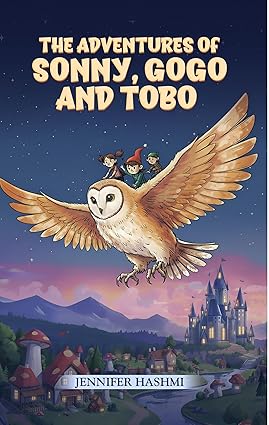
The Adventures of Sonny, Gogo, and Tobo by Jennifer Hashmi belongs firmly in the second category. On the surface, it reads like a classic fantasy, three boys riding giant owls across sky islands, solving puzzles, and outsmarting troublemakers. But underneath that adventure runs something deeper: a carefully layered story about what it means to live responsibly, love your community, and protect the world around you.
A World Built on Cooperation, Not Competition
The archipelago Hashmi builds, a cluster of floating islands including Pongoland, Flannon, Meridoland, and others, is not a utopia. It has economic tensions, political disagreements, and social inequalities. What makes it compelling is how its people respond to those pressures.
The islands depend on one another. Trade flows between them. Birds carry messages. Healers like the revered Mother Fulati serve the sick across every island without question. The children absorb this spirit of interdependence naturally, because they live inside it every day.
This resonates with something real. Many children grow up in communities where they watch adults argue over resources, point fingers at neighbors, or protect their own interests at the expense of others. Hashmi's world offers them a different picture, one where cooperation is not idealistic but practical. It works. And when it breaks down, everyone suffers.
Mother Fulati: The Original Environmental Steward
One of the most quietly powerful figures in the book is Mother Fulati, a healer who lives deep in the jungle of Pongoland, surrounded by medicinal plants. She does not cast spells. She does not wield political power. What she holds, and guards fiercely, is knowledge, a generations-old understanding of plants, herbs, and the natural world.
When a jealous king sends beetles to destroy her garden, she does not panic. She mobilizes. She and Sonny work quickly to protect the plants, confront the threat, and send a clear message: harm this garden, and you harm every island that depends on her medicines.
Children reading this scene encounter something most environmental lessons miss: the idea that nature is not just beautiful, it is functional. Mother Fulati's herbs heal broken bones. They reduce pain. They keep communities healthy. Protecting them is not a noble gesture. It is survival.
Hashmi never lectures here. She simply shows what happens when a garden is threatened and what it takes to save it. That kind of storytelling sticks.
Sonny's Growing Conscience
When readers first meet Sonny, he is a curious boy from Earth who stumbles into Pongoland and cannot quite believe his luck. Gogo's island is magical, warm, and endlessly exciting. Tobo, the youngest of the three, adds unpredictable energy to every situation.
But as the story unfolds across three parts, Sonny changes. He stops being a wide-eyed visitor and starts carrying real responsibility. By Part Three, he lies awake at night thinking about the future, about decisions that will affect real people, about what kind of leader he wants to become.
This arc gives young readers something valuable: a mirror. Most children know what it feels like to want someone else to solve the hard problem. Hashmi shows them a boy who learns, slowly, imperfectly, that growing up means stepping into that responsibility anyway.
The Flannon Problem: A Lesson in Economic Inequality
Among the most grounded storylines in the book is the island of Flannon. Unlike Pongoland, which buzzes with mines, factories, and industry, Flannon sits at the edges of the trade network, distant, underrepresented, and quietly resentful.
In one telling exchange, Sonny watches the tension unfold and says something sharp for a twelve-year-old: Flannon has rivers, woods, and fields. No island is actually poor. He argues that the problem is not resources; it is imagination, organization, and the willingness to develop what you already have.
This is not a simple "just work harder" moral. Hashmi complicates it. She shows how history, distance, and lack of leadership compound into real disadvantage. The lesson she plants is more nuanced: communities that fail to cooperate and invest in their own people create the conditions for conflict.
Children may not articulate this when they read it. But they feel it.
Secrets, Legacy, and What Gets Passed Down
Woven through the larger narrative is a mystery involving a lost prince, a secret marriage, and a disappearance that nobody has spoken about for twenty years. When it finally surfaces, publicly, dramatically, it reshapes how several characters understand their own families and their place in the world.
Hashmi handles this thread with real care. She does not sensationalize the revelation. Instead, she uses it to explore a quiet but powerful question: What happens when the secrets adults keep finally catch up with the next generation?
Children in the audience may not consciously connect this to their own families. But many will have experienced the strange feeling of learning something about their parents or grandparents that reframes everything. Hashmi normalizes that experience. She shows that the past does not disappear; it simply waits.
Why This Book Matters Right Now
In a media landscape where children are bombarded with content that rewards individual heroes solving individual problems, The Adventures of Sonny, Gogo, and Tobo quietly argues for something different. It argues for a messy, complicated, necessary community.
The environmental thread is not preachy. The social commentary is not heavy-handed. The mystery does not sacrifice the adventure. Hashmi holds it all together through strong characters who feel genuinely fond of each other, a world that operates on its own internal logic, and stories that trust children to understand complexity.
That trust, more than anything, is what makes this book worth reading aloud, passing around, and talking about long after the last page.