
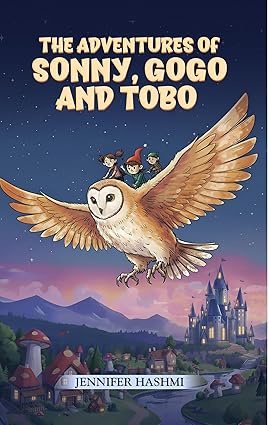
A look at the book that reminds readers why storytelling never really gets old
Some books walk readers into a world so quietly, so gently, that they are halfway through before they realize they are completely lost in the best way possible. Jennifer Hashmi's The Adventures of Sonny Gogo and Tobo: An Epilogue is exactly that kind of book. Published in 2020, this final installment of Hashmi's beloved series carries readers through a world of island kingdoms, mystical healers, time-slipping cellars, and young hearts navigating love and duty.
Anyone who has ever felt stuck between two worlds, between where they grew up and where they belong, will find something deeply familiar in these pages. Here are seven moments that make this epilogue genuinely unforgettable.
1. A Young Man Sitting at a Window, Quietly Aching
The story opens with Sonny, now twenty years old and Prince Regent of Pongoland, sitting at a Palace window, watching a valley he chose over his old life on Earth. He made a deliberate decision to stay. He gave up a different future. And still, some mornings, the weight of that choice finds him.
This opening moment lands because it does not dramatize grief. It simply shows a young person staring out a window, aware of everything he loves and everything he misses. That kind of quiet longing resonates with anyone who has ever made a big life choice and still sometimes wonders about the road not taken.
2. The Discovery of an Iron Ring in a Dark Cellar
Sonny and Gogo do not go looking for an adventure on the day they stumble into one. They are simply heading to the cellar for a drink when they find two young strangers, Tania and her brother Tenby, crouched over a hand-drawn map, searching for an iron ring rumored to open a portal between islands.
What makes this scene so alive is how immediately the five of them become a team. No suspicion. No formality. Just the shared electricity of a mystery begging to be solved. Hashmi captures that rare chemistry, the kind that happens in childhood and, if readers are lucky, a few times after.
3. Stepping Through a Door and Into Another Century
When the iron ring turns and the stone panel slides open, the five friends do not end up where they expected. They find themselves inside a beautiful house filled with people in old-fashioned clothes, laughing, holding wine glasses, entirely unaware of the visitors walking among them.
This moment works because Hashmi does not overexplain it. The confusion, the little dog barking at visitors no one else can see, the slow dawning realization that something in time has shifted it all, unfold in real time alongside the characters. Readers feel disoriented in exactly the right way.
4. A Ruined Castle and a Wrong That Waited a Century to Be Fixed
The group makes their way to the burnt-out shell of Sisko Castle and learns the story of Lancelot, a progressive lord who transferred ownership of farmland to his tenants, only to be killed before anyone found out. In the ruins, locked in an iron safe, those title deeds still wait.
There is something deeply satisfying about a buried injustice finally surfacing. Hashmi ties the personal and the historical together here in a way that feels earned. The five friends did not just stumble into an adventure; they were pulled toward a specific purpose. That sense of meaning beneath the surface gives the whole sequence a quiet power.
5. Mother Fulati's Explanation of Everything
Back in Pongoland, Sonny, Gogo, and Tobo bring their tangled experience to Mother Fulati, the island's Wise Woman, healer, and keeper of deeper knowledge. She listens. She asks the right questions. And then, gently, she helps them see what they were really part of.
Mother Fulati is one of the most quietly compelling characters in the series. She does not perform wisdom. She carries it. Her scenes feel like a good conversation with someone who has lived long and paid close attention to the kind of readers who wish they could have in real life.
6. A Father's Objection and a Grandfather's Quiet Override
When Sonny asks for Tania's hand in marriage, her father, Roman, refuses not because of Sonny's character, but because of his bloodline. Roman wants documented ancestry. He wants a pedigree. What he gets instead is Tristram, Tania's sharp and dignified grandfather, who already sees what matters.
This clash between inherited prejudice and earned character is one of the most relatable tensions in the book. Readers who have ever had to prove themselves to someone determined not to see them will recognize the sting of Roman's dismissal and feel the satisfaction of watching it slowly crumble.
7. Mother Fulati and the King: A Love That Chose Duty
Running beneath the entire story is a thread that only becomes fully visible near the end of the decades-long bond between Mother Fulati and King Ferdinand. They chose their callings over each other. They kept their vow. And they still speak in a language of complete understanding.
The scene in her kitchen, two people who sacrificed romantic love to serve something larger, and still carry warmth for each other without bitterness, is quietly one of the most adult and tender things in the book. Hashmi does not dramatize it. She simply lets readers sit with it.
Why This Book Stays With Readers
Jennifer Hashmi spent decades in India, trained in theology, served communities across continents, and then sat down to write stories about owls, island kingdoms, and young people learning what it means to belong somewhere. That life experience, real, textured, and full of genuine curiosity about people, shows on every page.
The Epilogue does not try to be a grand finale. It is something smaller and more lasting, a story about ordinary courage, about friendships that hold across dimensions, and about the quiet bravery of choosing where to plant roots. Readers who pick it up will find themselves reluctant to leave Pongoland behind.